Code review for agentic coders

Minimal setup. Zero noise.

Your agents ship all day. Codqual catches the subtle logic bug, the risky migration, the missing auth check, and the quiet drop in code quality before they land.

No config. No credit card.

Using Agents? Set up codqual for your agent in 2 minutes →
api/routes/users.ts
security data logic secrets
  router.get("/users", async (req, res) => {-   const me = await requireAuth(req)-   return db.query(usersForOrg, [me.orgId])+   const users = await db.query(allUsers)+   res.json(users)  })
codqual commented just now

HighAuth check removed

This route now returns every org's users.

The numbers

Catches what fast-moving agents miss.

25
rubric checks
2×
every finding checked, then verified, before it posts
0
config needed
100%
of your repo scanned on day one

Security, code quality, and logic checks that catch things like a removed auth check — before they ship — for the setup cost of installing a GitHub App.

Always on

Quality doesn't depend on who's around.

Busy weeks, days off, a Friday-afternoon rubber stamp. Codqual holds every PR and every scan to the same standard, always.

Connect your repo
PR reviews arrive
Scheduled scans run
Agents fix it autonomously

Connect once. Scans catch what reviews miss, agents fix what scans catch — nothing else to configure.

How it works

Five acts. Under sixty seconds.

Open a PR and a senior-level review lands before your coffee's done. Behind the scenes, your whole repo gets watched just as closely — on a schedule, automatically.

  1. 01

    PR opened, or a scan kicks off

    Scans run on a schedule or PR reviews run whenever a PR is created or updated.

  2. 02

    Context gathered

    Always read the right context. See contextualized code, never an isolated diff. Codqual also has memory and dreams so it gets better with time.

  3. 03

    Agents fan out

    Security, performance, logic, migrations — specialized reviewers read the code in parallel.

  4. 04

    Weak findings get dropped

    Findings must cite evidence and win reviewer agreement, or they're dropped.

  5. 05

    The review lands, or the score updates

    A PR gets findings and a fix in a minute. A scan updates your repo's maturity score.

Integrations

Plugs into how you already work

GitHub App — 2 clicks

Install on your org, pick repos — no webhooks or CI YAML to configure. Every PR gets reviewed; every repo gets scanned on a schedule.

Every PR reviewed, every repo scanned — the same way, no matter what wrote it:

Claude Code Codex Cursor Windsurf You
Start Free
codqual commented just now
High SQL injection in export endpoint api/routes/export.ts Resolved
Business impact

An attacker can read or destroy your database.

How to fix

Switch to a parameterized query — the fix is spelled out in plain English.

api/routes/export.ts:42
Medium Refund skips the fraud-hold check billing/refunds.ts
Business impact

This path assumes fraud holds are already checked upstream — they aren't.

How to fix

Call checkFraudHold() here too, matching every other refund path.

billing/refunds.ts:56
Coding agent replied just now

Fixed: switched to a parameterized query.

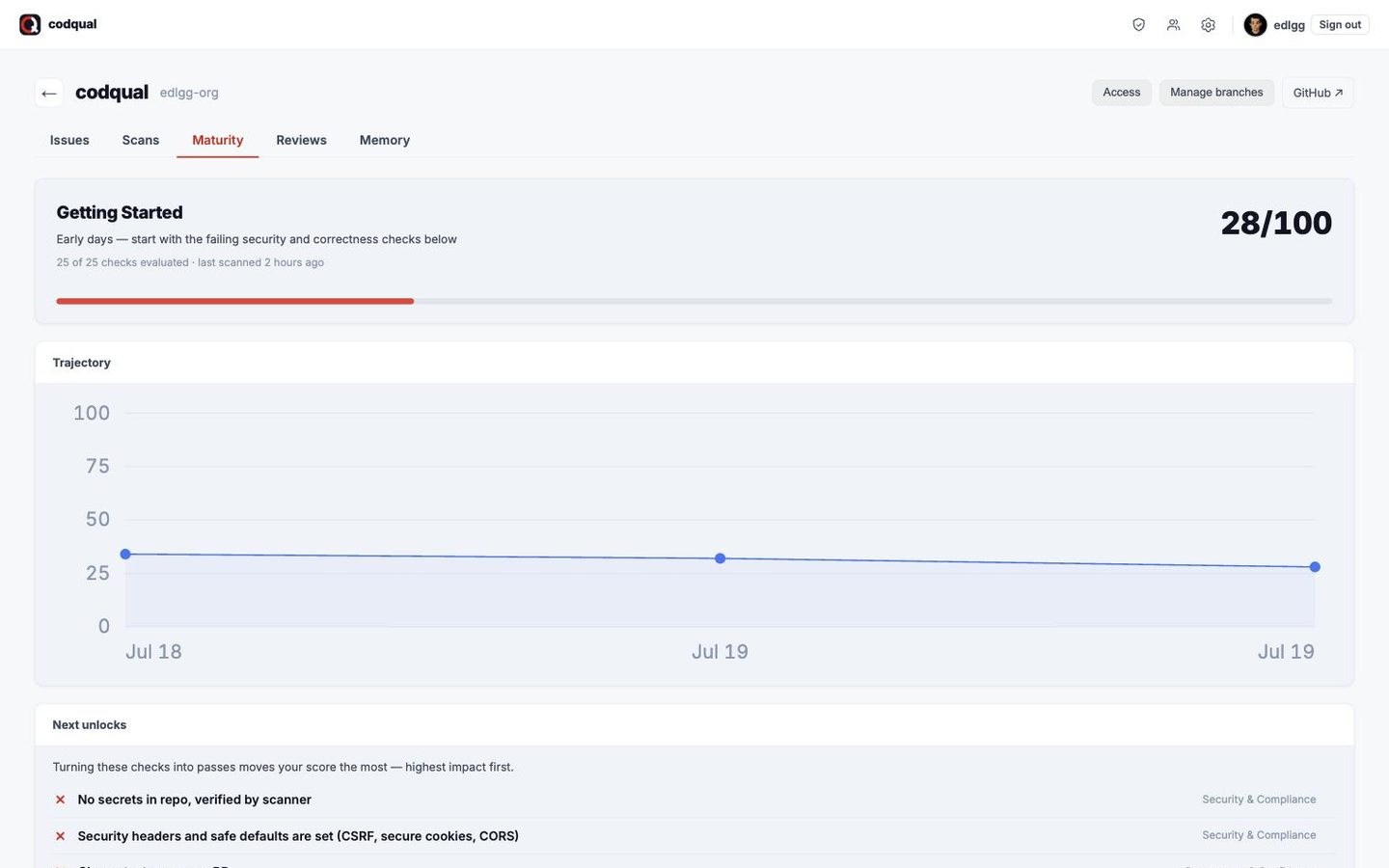
Maturity

A health score your whole team can read

Every repo gets a maturity score across the same 25-check rubric — watch it climb as findings get fixed.

82% maturity score
codqual maturity dashboard showing a repository health score
Pricing

Pricing that scales with your team.

Start free. Move up when you outgrow it — and every paid plan can top up with add-on credits at 50¢ each.

Free
$0 forever

Everything you need to review pull requests and scan your whole repo.

  • Open-source AI model
  • 100 PR reviews a month
  • 10 repo scans a month
  • Up to 3 members
  • Scheduled weekly scans
Register free
Squad
$29 per month

or $278.40 a year (save 20%)

For a small team shipping regularly.

  • Advanced AI models
  • 260 PR reviews a month
  • 40 repo scans a month
  • Up to 5 members
  • Add-on credits at 50¢ each
Choose Squad
Business
$799 per month

or $7,670.40 a year (save 20%)

For organizations that need custom teams and scale.

  • Advanced AI models
  • 2,500 PR reviews a month
  • 400 repo scans a month
  • Up to 100 members
  • Custom teams & multi-org
  • Add-on credits at 50¢ each
Choose Business
Enterprise
Contact Us

Custom scale with the controls and support a large organization needs.

Contact sales
  • Advanced AI models
  • Custom-scale allowances & unlimited members
  • SSO / SAML single sign-on
  • Custom teams & multi-org
  • Custom contract & dedicated support

What it catches

Cross-file logic

Complexity & incorrect abstractions

God objects, leaky layers, and the multi-file bug that's correct alone and wrong in context.

checkout and billing each reimplement tax rounding — and disagree
Code quality

Code that repeats itself

Logic copy-pasted across files, and exports nobody uses anymore.

formatPrice() pasted in 4 files — two copies already differ
Code quality

Functions that do too much

Code too long, too deep, or too tangled to safely change, in any language.

handleWebhook(): 240 lines carrying six responsibilities
Code quality

Changes that ship without a safety net

Pull requests without test coverage, and schema changes that lock tables or drop data.

ALTER TABLE on a 4.2M-row table — no test touches it
Best practices

Production readiness gaps

Missing health checks, stale dependencies, and the project basics that come back to bite you.

no /health endpoint — the orchestrator can't see it die
Security

Security vulnerabilities

Injection, broken access control, leaked secrets, and known CVEs — the classes that matter most.

sk_live_… committed in plaintext — rotate it now

And much more…

Scaling up

Built for developers. Ready for the whole team.

Every codqual organization is sharable with multiple users. Add teammates, their roles, create teams, and set policies.

Org roles

Owner, admin, member — every teammate's access starts with a role, not a shared login.

Teams

Group people into teams inside your org, then grant access to the whole team at once instead of repo by repo.

Per-repo access

Grant maintainer or viewer access to one repo at a time, to a person or an entire team.

PR enforcement policy

Set advisory or blocking per repo, choose the severity that triggers it, and decide what happens if a review has issues.

Security and trust

Your code, handled with care.

Do you train AI models on my code?

No — codqual has no training pipeline and never uses your code to train any model. To produce a review, codqual sends your code to LLM providers (Anthropic, and others via OpenRouter) solely to generate that review; how each provider handles data is governed by its own terms.

What does codqual send to the model?

The diff of your pull request plus bounded excerpts of the surrounding code — a window of lines around each changed or cited location, not entire files or your whole repository. codqual sends only what a reviewer needs to judge the change in context.

How long do you keep my code?

codqual keeps no standing copy of your repository. The working copy used for a review runs in a temporary workspace that is deleted the moment the review finishes.

What happens when I disconnect codqual?

Disconnecting a GitHub organization removes its repositories from codqual right away and stops all future reviews. codqual also asks GitHub to revoke its own access.

Which repositories can codqual see?

Only the ones you choose. codqual installs as a GitHub App with access scoped to the repositories you select during install — and you can change that selection any time from GitHub.

Who on my team can see findings?

Owners and admins see every repo and finding in the org by default — a centralized view meant for governance. Regular members see findings only for repositories they've been explicitly granted access to, directly or through a team; without a grant, a member sees nothing for that repo. Access is closed by default, never shared automatically across the org.
Register and get your next PR reviewed — and your whole repo scanned.

No config. No credit card. The first review lands on your next pull request; the first scan covers everything you already have.